


Application
The autonomous rock breaker is intended to support remote or reduced-intervention rock-breaking workflows. The practical benefits depend on machine condition, site layout, sensing, operator procedures and the approved operating mode.
- Operational consistency: The system can combine multiple information sources in real time to support repeatable rock-breaking decisions within configured limits.
- Adaptability: Learning methods can be evaluated against new environments, tasks and machine configurations through a controlled training and validation process.
- Safety: Remote operation may reduce the need for people to work close to the rock-breaking process, subject to site procedures, exclusion zones and independent safety systems.
- Robustness: Deployment design considers vibration, temperature, dust, impact loads and accumulated positioning error, with operating limits and fallback behaviour defined for the machine.
- Cost-Effective: The scalability of the reinforcement-learning algorithm means it applies to different rock-breaker configurations without significant additional cost.
- Reduced Human Intervention: Frees operators for other tasks and reduces the potential for human error.
Bridge Detection Features
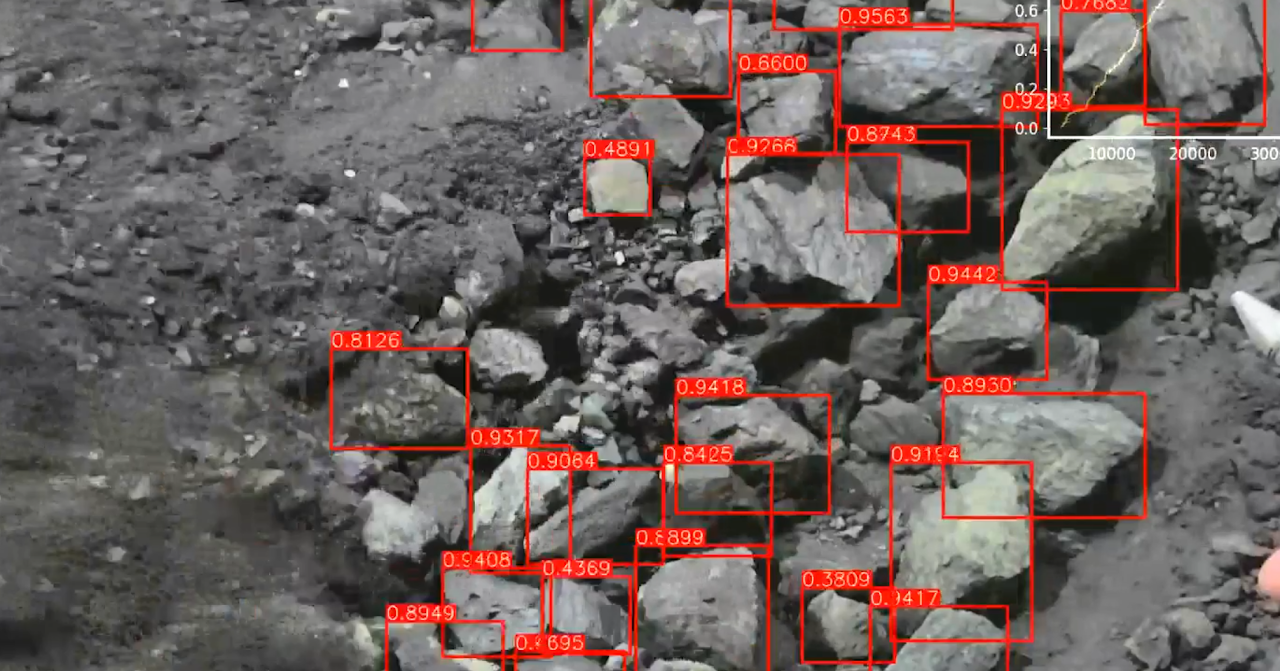
The integration of computer-vision technology into the autonomous rock breaker enables the system to detect, measure, and track rock bridges, providing the data needed for efficient, proactive, and safe operations.
Rock Bridge Detection and Segmentation. Rock bridges — arch-like structures of large rocks that block material flow — pose operational and safety risks. Advanced object-detection and segmentation techniques identify these bridges in real-time so the rock breaker can target them.
Measurement and Tracking. Beyond detection, the system measures the extent of rock bridges (size, shape, position) and tracks their evolution over time, enabling proactive management and predicting when and where breaking will be needed.
Key Element for Autonomous Operation. By providing accurate, real-time data on the operating environment, computer vision lets the autonomous system make informed decisions without human intervention.
Rock Breaker Arm Control
A rock breaker is a robotic arm with three joints, each providing a rotational degree of freedom. Inverse kinematics determines the joint angles required to position the breaker tip at a desired (x, y, z) location.
Given a desired position in 3D space, the goal is to find joint angles (θ1, θ2, θ3) that place the tip at that location — a combination of trigonometric and algebraic equations dependent on arm-segment lengths and joint orientation. There may be multiple solutions, or none if the position is out of reach. The computed angles drive the hydraulic actuators, repeated many times per second for smooth, accurate motion.
While exact inverse kinematics gives precise control, it is challenging in practice due to the machine’s size, harsh conditions, and the need for accurate position feedback — which is why Minealytics also employs reinforcement learning.
Minealytics Autonomous Rock Breaker Control
Minealytics offers a flexible, adaptable approach capable of handling the machine’s large momentum, inaccurate sensor feedback, harsh conditions, component wear and ageing, environmental change, and variable target bridge formations. By continuously learning from its interactions, the controller adapts its strategy to maintain optimal performance across a wide range of conditions.
- Large Momentum — learns to account for the machine’s momentum when positioning and moving.
- Inaccurate Sensor Feedback — interprets noisy data and makes optimal decisions despite uncertainty.
- Harsh Environment — continuously adapts to unpredictable changes in system dynamics.
- Wear and Ageing — updates its model of the system as components and hydraulics age.
- Changes in Environment — adapts to weather, terrain, and material variation.
- Variability in Target Bridge Formations — generalises across diverse bridge formations.
ROM Bin Autonomous Rockbreaking
For Run-of-Mine (ROM) bin operations, the system can support remote blockage clearance and earlier intervention. Computer-vision bridge detection can identify targets for operator-approved breaking workflows, while trajectory control and learning methods can be evaluated against wear, hydraulic-oil degradation and changing conditions before any live update is authorised.
Crusher Autonomous Rockbreaking
Over crushers, the speed and precision of rock breaking directly improve throughput and reduce bottlenecks, maintaining steady feed and maximising crusher utilisation. Computer vision identifies oversized rocks and obstructions before they reach the crusher, mitigating jams and equipment damage. Automated, intelligent trajectory control removes the need for manual intervention, improving safety, while continuous reinforcement learning adapts to equipment wear, rock-property variation, and environmental factors for a resilient, efficient, and safe process.
Technology
Reinforcement learning (RL) lets an agent learn to make decisions by acting in an environment to achieve a goal, learning from the consequences of its actions rather than being explicitly taught.
- Adaptability — adapts to new environments and improves over time.
- Handling Complexity — manages the series of complex decisions involved in positioning the arms and timing the break.
- Scalability — the same algorithm scales to different rock-breaker configurations.
- Robustness — handles uncertainty and variability in harsh, unpredictable conditions.
- Elimination of Manual Derivation — learns control strategies directly from interaction, avoiding manual derivation of control laws or kinematics.
- Continuous Learning and Improvement — the more it operates, the better it gets.
Operating mode
Configured per site
The approved operating mode depends on the site, available data, validation results and safety case. A capability may begin as monitoring or advice, then progress to supervised or closed-loop control. Existing PLC, DCS and safety interlocks remain the final authority on what equipment can do.
Read about deployment and assurance