


Autonomous Mine Intelligence
Autonomous Mine Intelligence
A reasoning and planning layer that sits above your mine control system. It evaluates the whole operation — capacity, performance and constraints — and orchestrates Minealytics’ advanced control and computer-vision systems to help the plant operate closer to its measured potential, within approved site boundaries.
One mind, every plant
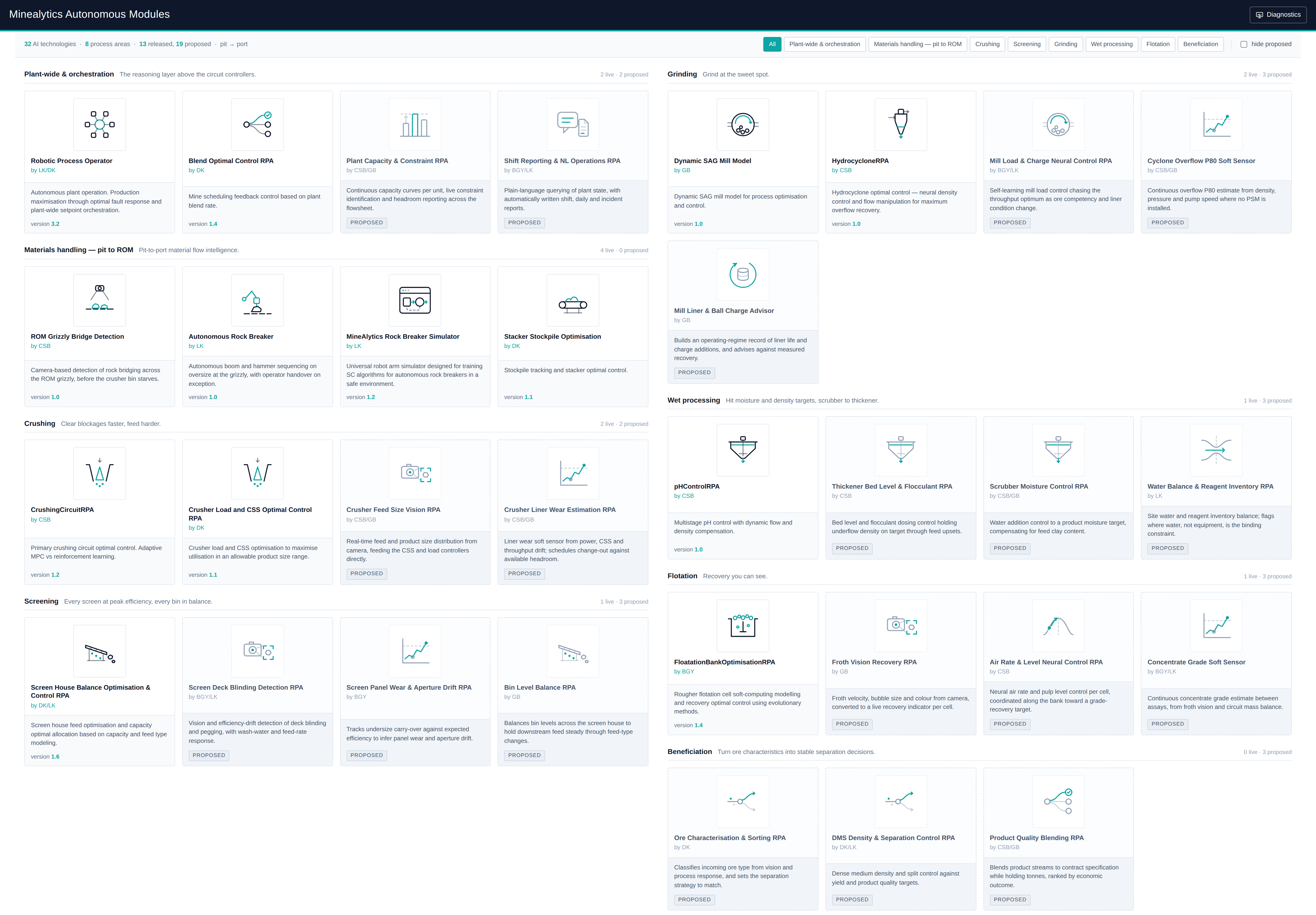
Every process area you've seen on this site — crushing, grinding, screening, wet processing, flotation, materials handling — connects to the same intelligence layer.
Autonomous Mine
Intelligence
- AI Analyser
- Global Optimiser
- Supervision
- Digital Twin & Simulation
- Knowledge & Memory
↑ live plant state · ↓ targets & setpoints
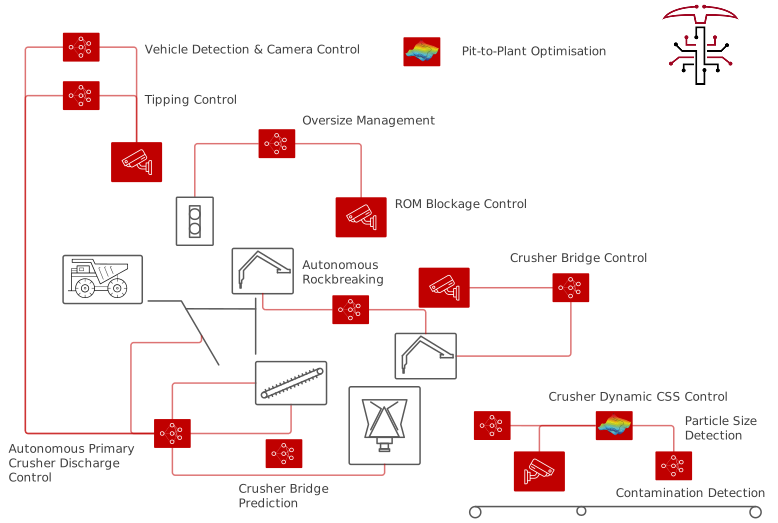
Crushing
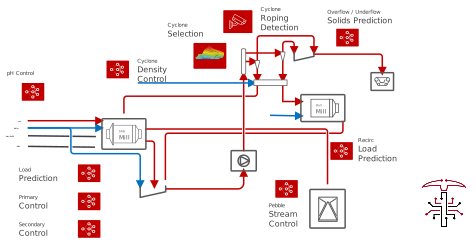
Grinding
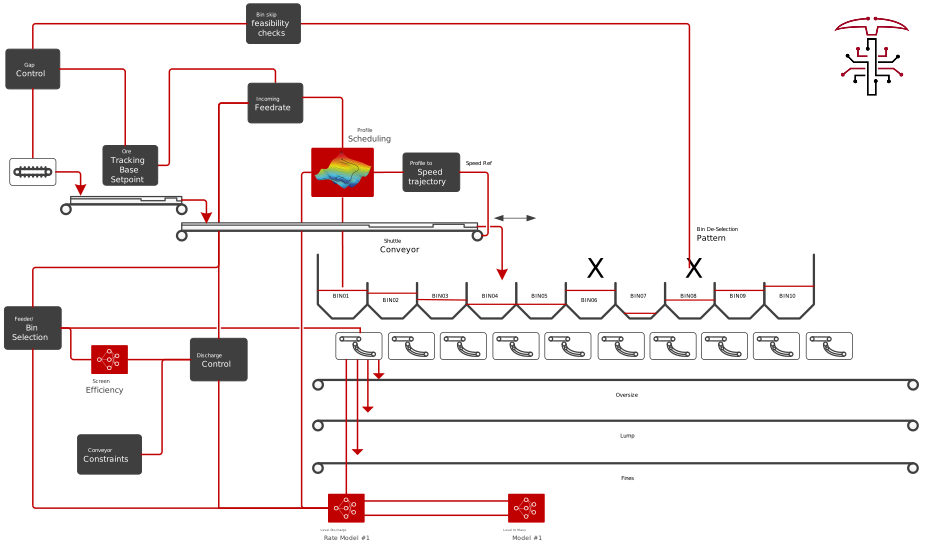
Screening
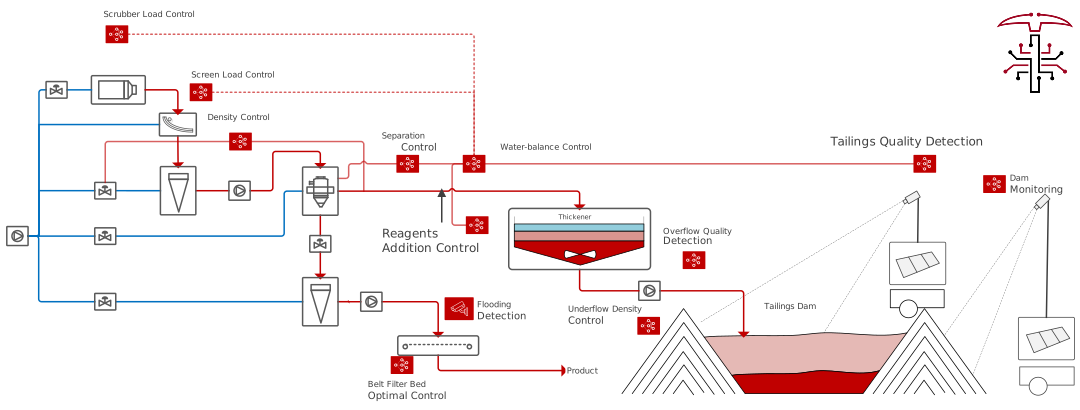
Wet Processing
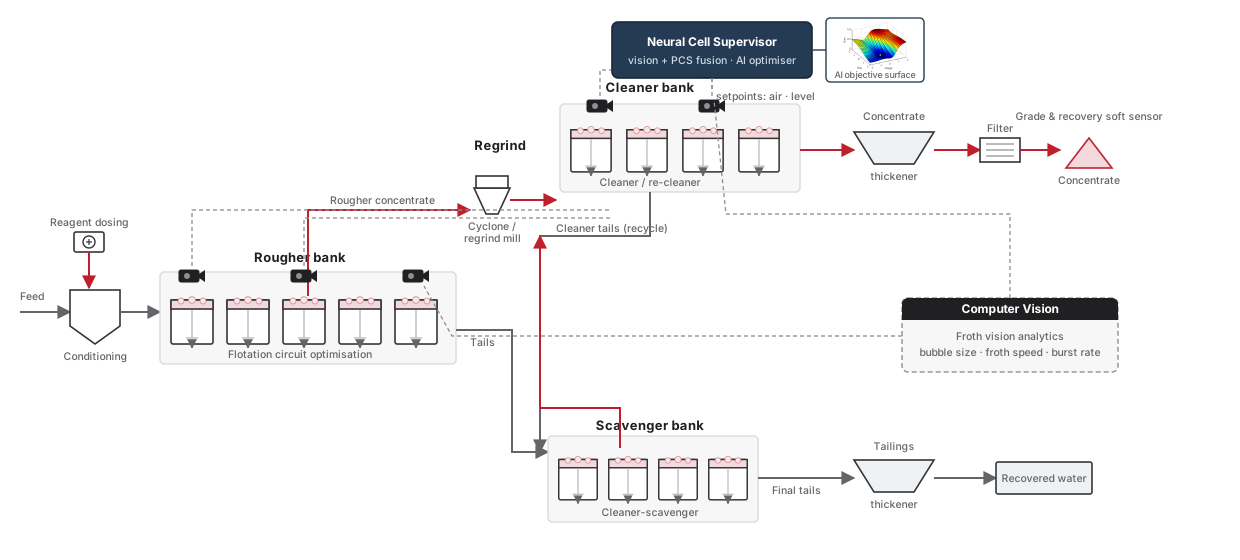
Flotation
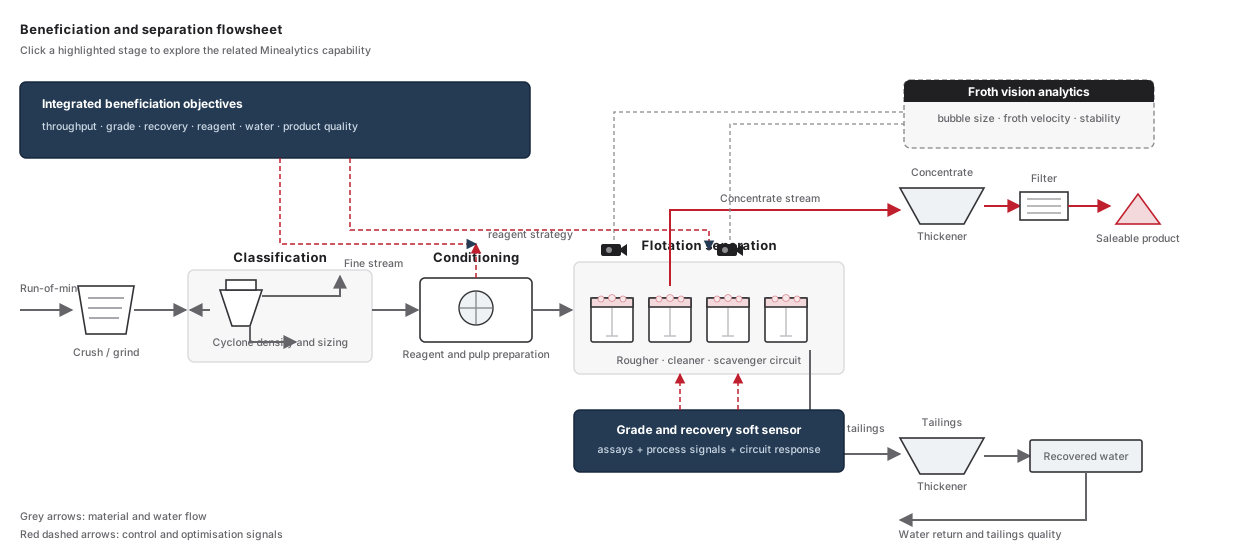
Beneficiation

Materials Handling
Drag the plants around. Where a site is connected, each area can stream its live state to the same intelligence layer and receive approved targets back from it. Click a plant to explore its solutions.
A mind on top of the muscle
The intelligence layer does not replace your control system — it sits above it. Regulatory control and expert controllers remain the safe, fast hands on the plant; the intelligence layer is the strategist deciding what they should be aiming for, and why.
Planning & reasoning
Capacity evaluation · performance measurement · constraint analysis · scenario planning · natural-language operations
Advanced control & computer vision
Governed process supervisors (Layer 3) and model-predictive control (Layer 2) — plus froth and material vision — executing approved targets across crushing, grinding, screening, wet processing and flotation.
Mine control system
Your existing DCS / PLC / SCADA regulatory loops, interlocks and permissives — untouched, and always the final authority on what the equipment is allowed to do.
Plant data & knowledge
Historian, computer vision, laboratory assays, maintenance and the operation’s own engineering knowledge — the ground truth the intelligence layer reasons over.
High-level planning, done continuously
The recurring analysis a metallurgical and operations team needs to make better decisions across each shift.

Equipment capacity evaluation
Continuously derives capacity curves and utilisation for every unit — crushers, mills, screens, cells, thickeners, conveyors — to locate the true constraint, quantify available headroom, and guide debottlenecking.

Process performance measurement
Tracks recovery, throughput, grade, energy and OEE across the whole flowsheet, detects drift and deviation early, and benchmarks live operation against the best regimes the plant has previously achieved.

Constraint & bottleneck analysis
Maintains a pit-to-port mass balance and reasons about where the operation is limited and by what — feed, water, air, reagent, inventory or downstream capacity — so effort is spent where it moves the plant.

Scenario planning & what-if
Simulates blend, feed, target and setpoint changes before they are committed, ranks the options by expected economic outcome, and hands the chosen plan down to the control layer to execute.

Natural-language operations
Operators and metallurgists ask questions in plain language and receive grounded diagnoses, recommendations and automatically written shift, daily and incident reports — the plant explains itself.

Continuous learning
Builds and maintains an operational knowledge base, recording operating regimes and recovery context so each shift can work from the evidence gathered before it.

Operator digital twin
A structured record of experienced operator responses. Where the data and safety case support it, learning methods can help compare recovery sequences for upsets and failures.

Plant simulation & digital twin
A web-based simulation of your plant — mass flow, control behaviour, production outcomes — where controllers are trained, tuned and validated before they ever touch real equipment, and what-if scenarios are tested without risking a tonne.
Under the hood
Powered by analytical and control tools
The intelligence layer is not a single model — it is an orchestrated team of analytical, optimisation and control tools, each doing what it does best, coordinated toward one goal: a better-run mine.
AI Analyser
Autonomously mines the historian and computer-vision streams for patterns, anomalies and cause-and-effect relationships, turning raw plant data into decision-ready insight without waiting for someone to build a report.
LLM analytical tools
Summarisation, extraction, classification and retrieval over plant data, engineering documents and operating knowledge — grounding every recommendation in your operation’s own context. Sensitive data is processed locally, behind a privacy gate.
Expert control tools
Minealytics’ advanced process control and computer-vision systems are the actuation layer the intelligence layer plans through: it sets high-level targets; the expert controllers execute them safely, within the plant’s existing limits.
Sense → reason → plan → direct → measure → learn
A closed loop that turns the whole operation into a system that improves itself.
- 01
Sense
Fuse historian, vision, laboratory and maintenance data into one live picture of the operation.
- 02
Reason
The AI Analyser and LLM tools find the patterns, causes and constraints behind the numbers.
- 03
Plan
Evaluate capacity and performance, simulate options, and choose the best high-level targets.
- 04
Direct
Hand those targets to the advanced controllers and the plant control system to carry out.
- 05
Measure
Score the result against the plan and an agreed operating baseline.
- 06
Learn
Fold the outcome back into the knowledge base so the next decision starts better-informed.
Authority that is earned, not assumed
Autonomous Mine Intelligence is advisory-first and operator-in-the-loop. Every recommendation is grounded in the plant’s own data and can be audited through its inputs, outputs and decisions. It escalates from insight, to recommendation, to supervised closed-loop control only as it earns trust, and it never overrides the safety limits and permissives of the underlying control system. It sits on top of the mine, but the mine remains in control.
Put a mind on top of your mine.
Talk to us about deploying Autonomous Mine Intelligence over your existing control system.