


Application
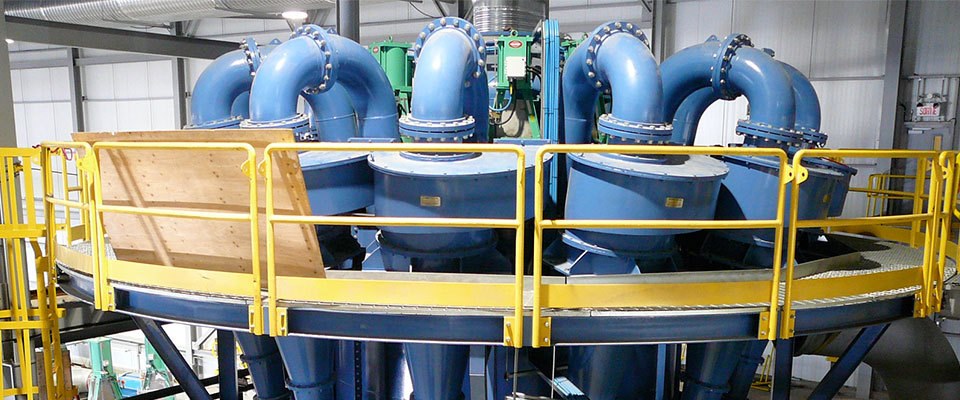
Selecting and deselecting cyclones in a cyclone bank aims to optimise the performance of the cyclone array under varying operational conditions. This is achieved by dynamically adjusting which cyclones in the bank are active (selected) or inactive (deselected) based on relevant process variables and conditions.
Factors such as feed rate, particle size distribution, slurry density, and desired cut size influence the decision to select or deselect cyclones. For instance, if the feed rate increases, additional cyclones may be brought online to handle the increased volume without compromising separation efficiency. Conversely, a decrease in feed rate might lead to deselection of some cyclones to avoid inefficiencies like overly dilute underflow.
Minealytics offers a number of predictive models for optimising and selecting cyclone banks. The overflow density model helps in maintaining the density by selecting and deselecting cyclones at a constant flow operation, where the feed pressure is constant. Water addition maintains this set pressure. The recirculation load changes (increases or decreases) as the feed density changes, causing the cut point of the cyclone to vary with the grinding capacity of the mill, so the product size increases or decreases accordingly.
The optimal control scheme sets the cyclone pressure automatically based on the Minealytics AI model for underflow density, and the optimal number of cyclones is determined based on the Minealytics predictive AI model for overflow density.
Solution: Neural Control
The Minealytics AI models continuously analyse a vast amount of data from sensors and process variables in real time. They use advanced algorithms, such as machine learning or deep learning, to learn from this data and make predictions about the cyclone’s performance. This allows for more accurate and dynamic adjustments than traditional methods. The advantages of using AI for cyclone density prediction include:
- Enhanced prediction accuracy: AI models can handle complex, non-linear relationships between variables, leading to more accurate predictions of cyclone density.
- Real-time optimisation: AI can process data in real time, allowing for immediate adjustments to optimise the cyclone’s performance.
- Adaptability: AI models can continuously learn and adapt to changing conditions in the cyclone, such as variations in ore type or particle size distribution.
- Reduced operator reliance: by automating the control process, AI reduces the need for manual intervention, leading to more consistent operations.
- Energy efficiency: optimised control of cyclone density can lead to more efficient separation processes, reducing energy consumption.
Minealytics AI models offer a more sophisticated and adaptable approach to cyclone density prediction and control compared to traditional pressure and PID-based systems. This leads to enhanced performance, consistency, and efficiency in mineral processing operations.
Utilising AI modelling for feedrate prediction also provides a powerful tool for performance evaluation of alternative or competing control strategies. With the ability to accurately predict future feedrate changes under varying conditions, AI models serve as a reliable benchmark against which different control methods can be assessed in a real or simulated environment. This enables continuous learning and data-driven decisions to optimise control algorithms, and to choose the most efficient and robust strategy at staging, thus reducing risks, minimising operational costs, and enhancing overall performance.
Cyclone Inlet Pressure and Overflow Density
The inlet pressure is a significant factor influencing the performance of a cyclone, impacting the separation efficiency and the characteristics of the overflow and underflow streams. The pressure at the cyclone inlet is directly related to the velocity of the slurry entering the cyclone. Higher inlet pressure results in higher slurry velocity, which can lead to a finer separation cut size. This means that smaller particles will be separated and included in the overflow. The density of the overflow, which contains the finer particles, is influenced by this separation cut size. Generally, a higher inlet pressure, by facilitating finer separation, can lead to a lower density overflow because it contains a higher proportion of fine particles, which are usually less dense than coarser particles. Conversely, a lower inlet pressure typically results in a coarser separation cut size, leading to a higher density overflow due to the inclusion of coarser, denser particles.
It is important to balance the inlet pressure to achieve the desired overflow density for the specific mineral processing application. Too high an inlet pressure might lead to excessive fines in the overflow, reducing the efficiency of separation. Too low a pressure might result in an overflow with too coarse a particle size, which is also undesirable. Understanding and controlling the relationship between cyclone inlet pressure and overflow density is critical for optimising the performance of the cyclone. It plays a key role in achieving the desired product quality and operational efficiency. Controlling inlet pressure along with overflow density allows separation efficiency and final product quality to be maintained in mineral processing. Effective management and control of this relationship are crucial elements of the Minealytics Neural Cyclone Density Control.
Predictive Alarming
Another use-case for AI models is predictive alarming. By leveraging the capabilities of AI to accurately forecast density changes, the alarm system can proactively notify operators of potential issues, such as equipment overloads or inefficiencies, well before they become critical. This enables timely interventions, minimises downtime, and allows for more optimal resource allocation. Moreover, the predictive nature of the system can adapt to the ever-changing conditions in the mine, such as varying ore properties, making it a highly dynamic and robust solution.
Operating mode
Configured per site
The approved operating mode depends on the site, available data, validation results and safety case. A capability may begin as monitoring or advice, then progress to supervised or closed-loop control. Existing PLC, DCS and safety interlocks remain the final authority on what equipment can do.
Read about deployment and assurance