


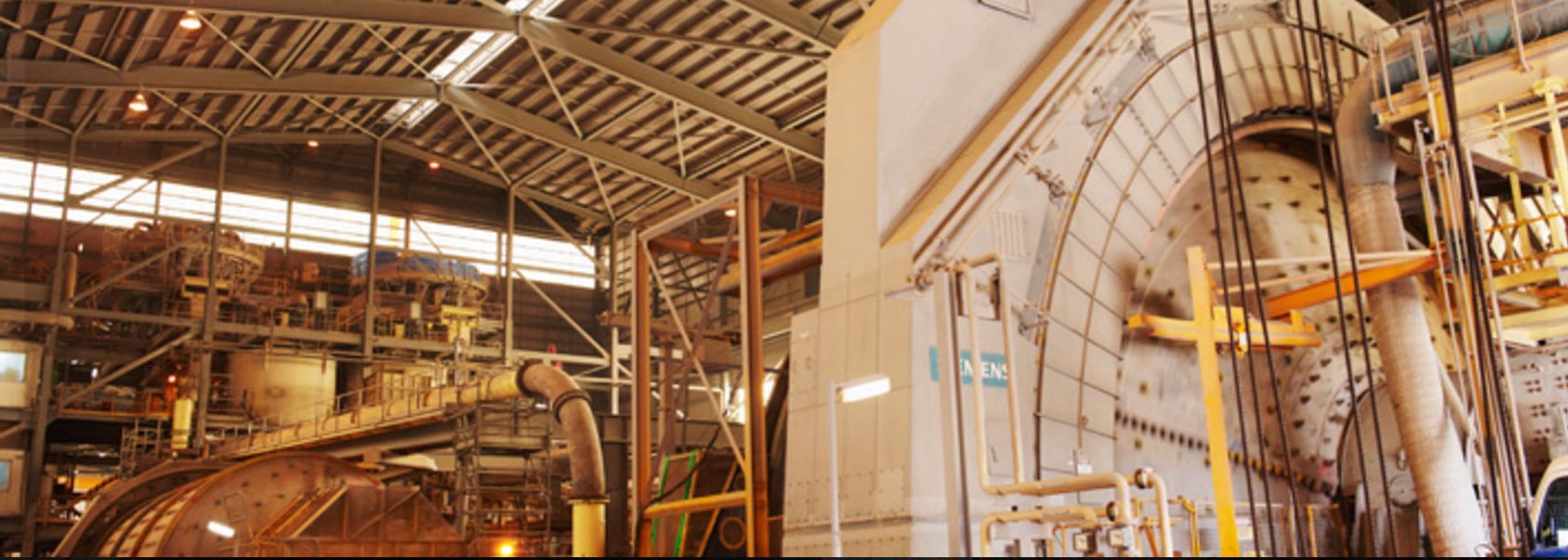
Application
Controlling comminution circuits, such as those involving SAG (Semi-Autogenous Grinding) mills, ball mills, and other grinding operations, is a complex task due to the large number of measured and hidden variables that affect the underlying processes. Different advanced control approaches, including theoretical and empirical model-based methods, have become widespread to address these challenges with only limited success.
Theoretical models are based on physical principles governing comminution, such as breakage mechanics and fluid dynamics. These processes are inherently complex, and models don’t capture all the nuances of the real-world operation. Empirical models require accurate estimation of parameters, which can be difficult to obtain in practice. These parameters vary over time as the ore characteristics or mill conditions change. Both theoretical and empirical models are often developed for specific scenarios or types of ore. They do not generalise well to different operational conditions or ore types. Furthermore, these models usually do not adapt well to changes in the process, such as wear of the mill liners, changes in ore hardness, or variations in feed size distribution.
These inefficiencies in the modelling and encompassing advanced control systems result in significant losses that manifest in downtime, production grade and throughput. Skills required to operate and maintain these advanced process control systems also pose significant challenges.
Solution: Machine Learning-based Mill Control
Minealytics specialises in AI-based control for mining applications. AI models, particularly those using machine learning, can adapt to changing process conditions more dynamically. They can learn from new data as it becomes available, making them suitable for environments where ore characteristics and operational conditions vary frequently. AI models excel in forecasting future process behaviour based on historical and real-time data. This predictive ability can be particularly advantageous in anticipating issues like equipment overload, maintenance needs, or changes in ore quality. AI models can identify and learn complex, non-linear relationships in data that might be difficult to model explicitly in traditional APC systems. They can effectively utilise vast amounts of historical and real-time data, extracting valuable insights that might be missed by traditional methods. As more data is collected, AI models can be retrained and improved, potentially increasing their accuracy and reliability over time. They can also easily integrate diverse data sources, including sensor data, operational parameters, and external factors like weather, which might impact the comminution process.
As an alternative to complex and expensive Advanced Process Control or Expert Control systems, it is recommended to implement a robust high-level control scheme in the existing control system that provides mass balance control around the SAG (feed and classification constraints). The high-level control can then be extended with AI models as required (motor power, mill weight, grinding, circulating load, etc.).
A complex non-linear, multivariable process like the mill load can be best modelled by a machine learning model. The Minealytics Mill Load Prediction model can adapt to changes in real time, making it highly responsive to variations in ore characteristics, equipment wear, and other operational conditions. As more data is collected, the model can improve its predictions, enhancing the control strategy over time.
By predicting the mill load and simulating other process variables, the model can find the optimal set points for feed rate, water addition, and mill speed, to maximise throughput while staying below a high load limit.
Better control of mill load can lead to a more consistent product size, which is crucial for downstream processes like flotation or leaching. By avoiding conditions that lead to overgrinding, the model can improve the recovery rates in downstream processes and reduce the consumption of grinding media. Operating at the highest possible load without crossing the limit can maximise throughput, leading to increased production rates. Predictive models can foresee problematic conditions and allow for preventive actions, reducing unscheduled downtimes.
The Minealytics Mill Load model can be tailored to the specific characteristics and requirements of each milling operation (feature and data engineering combined with process knowhow).
Each Minealytics Control Module has three layers of operation:
- Insights and diagnostics: the model can provide valuable insights into the milling process, helping operators and engineers make more informed decisions.
- Scenario analysis: the predictive optimisation scheme can simulate different scenarios, aiding in planning and decision-making.
- Online control: the model can provide input to the underlying control scheme by prescribing bounded setpoint trajectories or predictive process values. Closed-loop use depends on site validation, operator approval, fallback behaviour and the control-system safety case.
Technology
The Minealytics Mill Control models compare candidate AI architectures against the plant’s own data and the control objective. The selected model is monitored against measured process behaviour after deployment.
In time series modelling, the goal is to predict future values based on past observations. This can include forecasting future sales, predicting equipment failures, or anticipating market trends. The model is trained on a dataset where the desired output (like future sales) is known for past time points. The model learns to associate patterns in the input data with these outcomes.
Attention mechanisms allow a model to focus on specific parts of the input sequence that are most relevant for making a prediction. This is particularly useful in long sequences where certain segments are more informative. Originally developed for natural language processing, transformers use self-attention to weigh the importance of different parts of the input data. They are highly effective in capturing long-range dependencies in data. In time series, attention models can identify crucial time steps that most significantly influence future values, improving the accuracy of long-term forecasts.
1D convolutions can be used to process temporal information, capturing patterns across different time scales. CNNs can efficiently handle large datasets and can capture complex patterns in the data, making them suitable for a variety of forecasting tasks.
Originally developed for generating high-quality audio, WaveNet is a deep neural network that uses dilated convolutions to process time series data. These allow the network to have a very large receptive field, meaning it can consider information from many previous time steps without a significant increase in computational complexity. WaveNet can be particularly effective for long-term predictions in time series data due to its ability to capture long-range dependencies.
Operating mode
Configured per site
The approved operating mode depends on the site, available data, validation results and safety case. A capability may begin as monitoring or advice, then progress to supervised or closed-loop control. Existing PLC, DCS and safety interlocks remain the final authority on what equipment can do.
Read about deployment and assurance