


Application
Conveyors move the bulk of an operation’s material, yet most plants know surprisingly little about what is actually on the belt at any moment. Belt weighers report total mass at a single point; between weighers, the volume, distribution and position of material on the belt are invisible. Overloading toward the belt edge and belt mis-tracking are typically discovered only after the consequence — spillage, belt-edge damage or an unplanned stop.
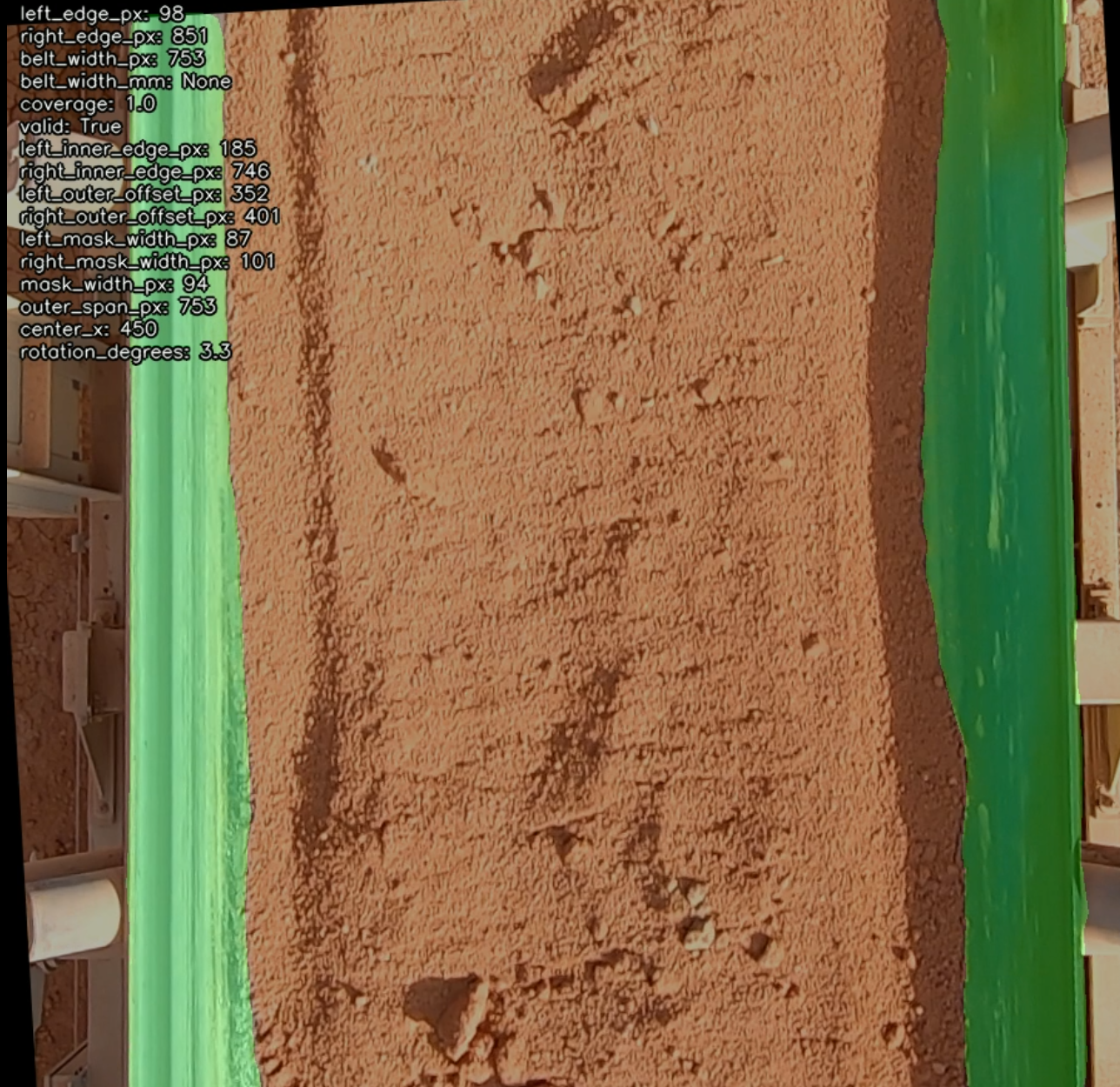
Minealytics Ore Profile & Belt Edge Detection places a down-facing camera above the running belt and continuously extracts two coordinated measurements:
- Volumetric profile scanning: the camera continuously measures the cross-section profile of ore on the belt. Combined with belt speed, this yields real-time volumetric flow, and — calibrated against belt weighers and material density — mass flow and the distribution of material across and along the belt.
- Belt edge clearance and tracking detection: segmentation neural networks monitor clearance bands along the left and right belt edges, outputting the minimum left and right edge distance in millimetres, with per-measurement confidence and health signals.
Together these give a live picture of what the belt is carrying, where it sits on the belt, and how close loading is to the edge.
Solution
The live volume and mass tracking feeds directly into downstream applications: constant-volume conveyor control, surge mitigation at transfer chutes, and inventory tracking across the materials-handling chain. The belt itself becomes a measured, controllable part of the process rather than a blind segment between weighers.
Edge clearance detection catches over-loading toward the belt edge and belt mis-tracking before spillage or belt damage occurs. The system integrates with the plant PLC:
- Low and low-low clearance alarms raised in the control system, where operators already work.
- Watchdog and communications-loss detection, so a silent sensor can never be mistaken for a healthy belt.
- An engineering dashboard showing the live camera feed with edge overlay and clearance statistics, for tuning, investigation and condition review.
Technology
The sensing hardware and calibration are engineered for the realities of a running conveyor:
- High-resolution global-shutter camera mounted directly above the belt, with short exposure times that freeze motion at belt speeds of around 5 m/s.
- Industrial LED lighting for consistent imaging across day and night operation.
- Compact AI edge controller beside the camera, processing the video stream locally with no dependence on remote infrastructure for time-critical sensing.
- Explicit, versioned calibration — camera intrinsics, mounting geometry, planar mapping and belt-curvature compensation — so edge distances and profiles are reported in real millimetres, not pixels.
The system is designed to be robust to dust, moisture, variable lighting and lens fouling. When conditions degrade, it degrades gracefully: every measurement carries a confidence value, and health signals report the state of the sensor itself, so the system never fails silently.
Operating mode
Configured per site
The approved operating mode depends on the site, available data, validation results and safety case. A capability may begin as monitoring or advice, then progress to supervised or closed-loop control. Existing PLC, DCS and safety interlocks remain the final authority on what equipment can do.
Read about deployment and assurance