


Application
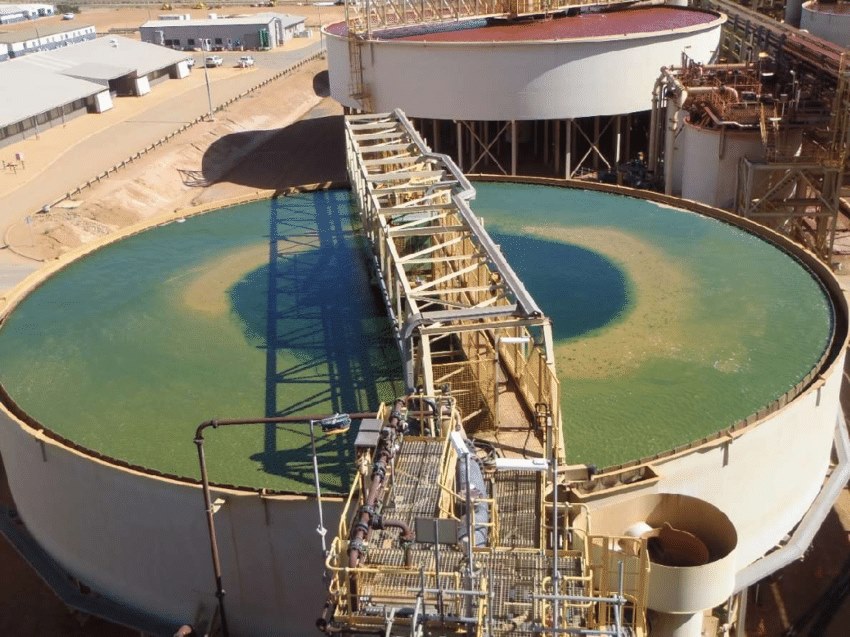
The Minealytics Thickener Overflow Quality Monitoring System uses computer vision and wet-plant data to monitor overflow clarity and support thickener operation. The control response and any closed-loop use are defined and validated for the site.
Overview of the System
Stage One: Wet Plant Water Usage Optimisation
- Objective: address the root cause of excess water generation in tailings dams.
- Methodology: optimal control of water usage in the wet processing plant through a data-driven approach.
- Implementation: use of AI models to regulate water use in wet separation technologies like cyclones, upcurrent classifiers, and belt filters, transitioning from constant flow, variable density mode to a more efficient variable flow mode.
Stage Two: Computer Vision-Based Monitoring
- Objective: detect and track potential tailings issues using advanced computer vision techniques.
- Technology: integration of data science, deep learning, and computer vision for real-time monitoring and anomaly detection.
- Application: continuous surveillance of the thickener for visual anomaly detection in the overflow.
Stage Three: Feedback Loop and Control
- Objective: integrate the feedback from the overflow quality monitoring into the thickening process for closed-loop control.
- Methodology: data-driven control methodologies to adapt to varying slurry properties and optimise thickener performance.
- Result: enhanced water recovery and bed separations in the thickening process, reducing direct wastewater flow to the dam.
Key Features of the System
- Compatible with existing camera infrastructure.
- Integration with wet plant processes: linkage of monitoring outputs with wet-plant signals through an approved site interface.
Solution: Minealytics Thickener Overflow Quality Monitoring
The Minealytics Thickener Overflow Quality Monitoring system uses cameras, and optionally other instrumentation, to continuously monitor the thickener overflow. These cameras capture real-time images or videos of the overflow.
- Clarity classification: the AI model, trained on a dataset provided by site experts, classifies the clarity of the thickener overflow. This classification could be in discrete categories such as clear, slightly turbid, turbid, etc. These categories are predefined based on industry standards or specific site requirements.
- Adaptive learning: the AI model is not static. It can learn and adapt by being retrained on new data. This means if there are new types of overflow qualities or changes in the existing types, the system can be updated to recognise these new patterns.
- Generalisation and environmental adaptation: a key feature of this AI system is its ability to generalise. This means it can account for changing process or environmental conditions that might alter the appearance of the overflow but not its quality. For example, different lighting conditions or minor changes in composition that don’t affect the actual quality would not mislead the system.
- Integration with existing systems: the AI and computer vision system can be integrated with existing turbidity meters. This integration allows for a more comprehensive monitoring approach, combining traditional sensor data with advanced image analysis.
- Reagents optimisation: the system can also be integrated into existing reagents optimisation schemes. By providing real-time data on overflow quality, it can help in adjusting the quantity and type of reagents used in the process, leading to more efficient and cost-effective operations.
- Data-driven decisions: with continuous monitoring and analysis, the system provides valuable data that can inform decision-making processes. This could lead to more efficient operations, reduced waste, and improved environmental compliance.
- User interface and alerts: the system includes a user interface for monitoring and alerts. This interface displays real-time data and trends, and sends alerts in case of anomalies or when the overflow quality falls outside acceptable ranges.
- Scalability and customisation: the system can be scaled and customised according to different site requirements or specific operational needs.
Technology: Convolutional Neural Networks
Designing a Convolutional Neural Network (CNN) for binary classification to recognise overflow-quality events in the thickener involves several steps. This process includes data collection and preparation, architecture design, training, and deployment. Here’s a detailed breakdown.
1. Data Collection and Preparation
- Collecting images: capture a large number of images of the thickener overflow showing both normal operation and overflow-quality events. Ensure varied lighting and environmental conditions are represented.
- Labelling: annotate these images, labelling them as ‘Normal’ or ‘Overflow’. This step is critical for supervised learning.
- Preprocessing: standardise the images (resize, normalise pixel values, etc.). Consider augmenting the data set with techniques like rotation, flipping, or adding noise to improve the model’s robustness.
2. Architecture Design
- Input layer: design the input layer to accept the standardised image size.
- Convolutional layers: these layers extract features from the images. Use multiple convolutional layers, with each layer detecting more complex features. Include activation functions like ReLU to introduce non-linearity.
- Pooling layers: following convolutional layers with pooling layers (like max pooling) reduces the spatial size of the representation, lowering the number of parameters and computation in the network.
- Fully connected layers: after several convolutional and pooling layers, add one or more fully connected layers for classification. These layers use the features extracted by previous layers to determine the image’s class.
- Output layer: since it is a binary classification (Normal or Overflow), the output layer should have a single neuron with a sigmoid activation function, which outputs a value between 0 and 1, indicating the probability of an overflow event.
3. Training the CNN
- Loss function: use a binary cross-entropy loss function, which is suitable for binary classification problems.
- Optimiser: choose an optimiser like Adam or SGD for adjusting weights during training.
- Validation set: split the data into training, validation, and test sets. The validation set helps in tuning the hyperparameters and avoiding overfitting.
- Training: train the network using the training dataset. Monitor the performance on the validation set to adjust parameters like learning rate, number of epochs, or layers.
4. Evaluation and Tuning
- Performance metrics: evaluate the model using metrics like accuracy, precision, recall, and F1 score.
- Tuning: based on the evaluation, tune the model by adjusting its architecture, hyperparameters, or training data.
- Overfitting check: ensure that the model is not overfitting the training data. Techniques like dropout, regularisation, or augmenting more data can help.
5. Deployment
- Integration: integrate the trained model into the monitoring system for real-time analysis.
- Monitoring and updating: continuously monitor the model’s performance in real-world conditions and update or retrain as necessary.
Challenges and Considerations
- Varying conditions: the model should be robust to variations in lighting, material properties, and process conditions.
- Real-time processing: the CNN must process images quickly enough to allow real-time detection and response to overflow events.
- Resource constraints: consider the computational resources available, as more complex models require more processing power.
Operating mode
Configured per site
The approved operating mode depends on the site, available data, validation results and safety case. A capability may begin as monitoring or advice, then progress to supervised or closed-loop control. Existing PLC, DCS and safety interlocks remain the final authority on what equipment can do.
Read about deployment and assurance